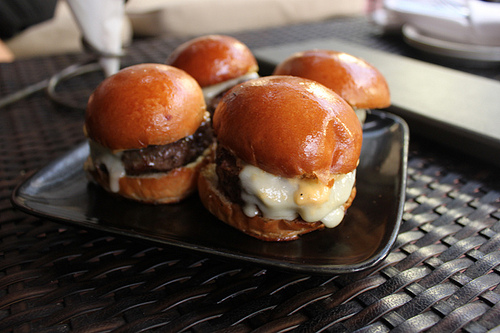
photo by Flickr/cherrylet
For those of you who have spent even a small amount of time with me, you probably already know that I’m one of those people who likes to study weird things about … well, everything. Especially when it comes to food and drink topics.
I was absolutely fascinated when I learned that Chilean sea bass doesn’t come from Chile. (The name is a euphemism, devised by wholesalers to make Patagonian toothfish from the Southern Ocean sound more appealing to Americans.) I was thrilled to learn the difference between whiskey with an “e” and whisky with a “y” (no “e” for the Scottish or Canadian stuff), and I was absolutely floored to discover I had been butchering the name of my favorite champagne for years. (Next time, I’ll ask for a glass of Mo-wett, NOT Mo-ay.)
So, you can imagine my horror (gasp!) and delight when I stumbled across this Forbes article that matter-of-factly proclaimed there is no such thing as Kobe beef in America.
WHAT?!! But what about those amazing Kobe beef sliders I just scarfed down at TAG last weekend? Or those Kobe short rib tacos I nearly inhaled at Linger? Nope, apparently they were both made of ultra-juicy, ultra-false “faux-be beef.”
I highly recommend that you read the entire four-part series of the article, since it’s really well written and well researched, but for those of you who want immediate answers, here’s the gist:
- “Real” Kobe beef is made in a specific place (the Hyogo prefecture in Japan), from a specific breed of cattle (Tajima-gyu) that is produced under specific rules.
- All beef from Japan is illegal to import to the U.S., even if it’s brought over in personal luggage.
- Buying “American Kobe beef” or “Domestic Kobe beef” is on par with buying “Domestic Russian caviar” or “Idaho-farmed Maine lobsters.”
- “Wagyu” just means “Japanese cows,” and it has about as much regulation as the “all-natural” label.
What’s next, Swiss chocolate made in China? Hmm…
 the lucky dipper